

Quick answer
A UGC content strategy defines how you collect, manage, price, distribute, and measure user generated content across your funnel.
Start with the job: do you need social proof for product pages, creator videos for paid ads, organic content for social, or customer language for SEO? Each job needs a different collection method, rights workflow, budget, and measurement plan.
Without strategy, UGC becomes random assets in a folder. With strategy, it becomes a repeatable content pipeline.
What is a UGC content strategy?
A UGC content strategy is a plan for using content from customers, creators, and community members to support a marketing goal.
It answers:
- What to collect: reviews, creator videos, customer photos, testimonials, AI UGC, Q&A.
- Who creates it: customers, creators, influencers, employees, AI tools.
- What rights you need: organic reposting, paid ads, editing, duration, territory.
- Where it goes: product pages, ads, email, landing pages, organic social, SEO.
- How success is measured: conversion, CTR, CPA, watch time, review volume, revenue impact.
The goal is not just to collect more UGC. The goal is to make each asset useful.
Step 1: Define the job before the format
Do not start with “we need more UGC videos.” Start with the business job.
| Job | Useful UGC format | Common mistake |
|---|---|---|
| Reduce purchase anxiety | Reviews, customer photos, testimonials | Hiding proof below the fold |
| Test paid social hooks | Creator videos, AI UGC variations | Making one polished brand ad |
| Improve product pages | Reviews, Q&A, video demos | Collecting content without placement |
| Support email | Short quotes, review snippets | Sending generic brand copy |
| Localize creative | AI UGC, localized creator briefs | Translating one ad literally |
Choose one primary job first. Build the workflow around that, then expand.
Step 2: Choose your UGC sources
Organic UGC from customers
Organic UGC includes customer reviews, tagged posts, unboxing photos, product photos, and comments.
It is strong for trust because it comes from real customers, but it is harder to generate predictably.
Ways to increase organic UGC:
- post-purchase review requests,
- packaging prompts,
- branded hashtags,
- review widgets,
- community prompts,
- support follow-ups after positive outcomes.
Paid UGC creators
Paid UGC creators produce content assets for brands. They may or may not post the content themselves.
Use creator UGC when you need:
- predictable volume,
- specific scripts,
- platform-specific formats,
- product demos,
- paid social variations,
- content from different demographics or use cases.
Creators should be briefed clearly on claims, tone, product details, usage rights, revisions, and deadlines.
AI UGC tools
AI UGC tools can generate avatar presenters, product scripts, localized versions, and hook variations.

They are useful for speed and variation. They are weaker when the campaign depends on real customer proof.
For tools, read best AI UGC tools.
UGC pricing and budgeting
UGC pricing varies by region, niche, creator experience, deliverables, usage rights, revisions, exclusivity, and whether the creator posts the asset.
Treat any numbers as planning ranges, not fixed market rates.
Creator UGC pricing factors
| Factor | Why it changes price |
|---|---|
| Video length | Longer videos need more filming and editing |
| Number of hooks | More hooks mean more creative work |
| Raw footage | Gives the brand more editing flexibility |
| Paid usage | Ads require clearer rights and usually higher fees |
| Exclusivity | Limits the creator’s future work |
| Niche complexity | Finance, health, SaaS, and regulated topics need more care |
| Turnaround | Rush work often costs more |
Usage rights
Usage rights are often more important than the base creation fee.
Define:
- organic vs paid usage,
- platform,
- duration,
- territory,
- editing rights,
- whitelisting or Spark Ads,
- exclusivity,
- renewal terms.
Do not assume paid ad rights are included unless the agreement says so.
AI UGC tool budgeting
AI UGC tools usually shift cost from per-creator production to subscription, credit, or usage-based pricing.
Before choosing a tool, check:
- monthly credits,
- export limits,
- avatar limits,
- video minutes,
- commercial rights,
- watermark rules,
- API access,
- cancellation terms,
- region and tax differences.
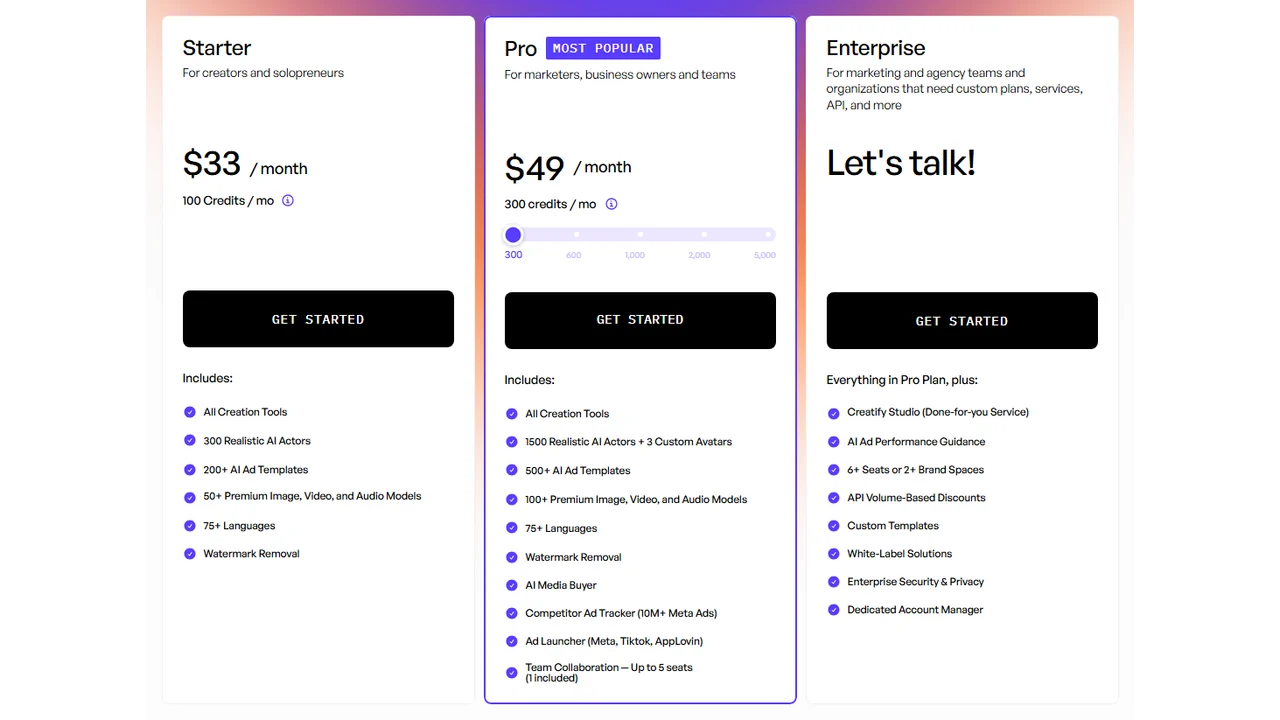
Pricing screenshot note: AI UGC tool prices, credits, minutes, commercial rights, and plan limits can change and may vary by region, currency, taxes, billing cycle, promotions, and account type, so verify current details on the official site before buying.
Step 3: Build the collection workflow
For reviews and organic UGC
- Ask for reviews after the customer has had time to use the product.
- Make the review request easy to complete.
- Monitor social mentions and tagged posts.
- Ask permission before reuse.
- Store approved assets with rights notes.
For creator UGC
- Define the brief.
- Source creators.
- Agree on rate and usage rights.
- Ship product or provide access.
- Review scripts or outlines when needed.
- Review final deliverables.
- Store raw files, final files, contracts, and usage terms together.
For AI UGC
- Choose a tool based on format.
- Write short scripts with specific hooks.
- Generate variations.
- QA for accuracy, claims, and disclosure needs.
- Compare against real creator content.
Step 4: Distribute UGC where it performs
A UGC strategy without distribution is just collection.
| Asset type | Primary placement | Secondary placement |
|---|---|---|
| Creator video | Paid social ad | Product page, organic repost |
| Customer photo | Product page | Email, organic social |
| Written review | Product page | Email, search snippets |
| AI UGC variation | Paid social test | Localization test |
| Testimonial quote | Landing page | Email nurture |
The same asset can be reused, but not every asset belongs everywhere. A raw unboxing may be perfect for TikTok and weak for a homepage. A concise review quote may work better near checkout.
Step 5: Measure and iterate
Measure based on placement.
Paid social metrics
- CTR,
- CPC,
- CPA,
- conversion rate,
- hold rate,
- average watch time,
- thumb-stop rate,
- qualitative comments.
Product page metrics
- conversion rate,
- add-to-cart rate,
- scroll depth,
- review engagement,
- returns or support questions.
Organic and email metrics
- engagement rate,
- click-through rate,
- revenue per email,
- saves and shares,
- reply quality,
- follower-to-customer behavior where trackable.
The real value is the loop: performance data should shape the next brief.
UGC strategy by business type
Ecommerce and DTC
Start with reviews and creator videos. Use reviews on product pages and creator videos in paid social.
Then test AI UGC variations for hooks, localization, and supporting edits.
SaaS and apps
Use customer quotes, short demos, founder-style clips, and creator explainers. UGC in SaaS often works best as trust support on landing pages and retargeting, not only as feed content.
Marketplaces and platforms
Focus on review volume, seller/customer stories, Q&A, and community proof. The SEO value of user language can compound over time.
Local services
Use testimonials, before-and-after content, customer reviews, and short explanation clips. Permission and claim accuracy matter.
Common UGC strategy mistakes
Collecting without distribution
If the content never reaches product pages, ads, email, or social, it is not a strategy.
Skipping rights
Do not use customer or creator content commercially without permission. Rights should be part of the workflow, not an afterthought.
Treating all UGC the same
A review, an AI avatar video, a creator demo, and a customer photo do different jobs. Segment by asset type and placement.
No feedback loop
If the paid social team learns which hooks work but the creator brief never changes, the strategy is wasting data.
Confusing AI UGC with real proof
AI content can scale variations. It should not pretend to be real customer experience.
UGC content strategy checklist
Before scaling, make sure you have:
- one primary objective,
- defined asset types,
- source channels,
- creator brief templates,
- rights language,
- review and approval flow,
- asset library,
- naming conventions,
- distribution plan,
- performance metrics,
- iteration cadence.
FAQ
What is a UGC content strategy?
It is a plan to source, manage, distribute, and measure content created by users, customers, or creators toward a marketing goal.
Which UGC should I collect first?
It depends on the goal. For ecommerce, customer reviews and photos are a good base. For paid social, creator videos and hook variations.
Can I use UGC in ads?
Yes, but you need clear usage rights. The agreement should state platforms, duration, editing, whitelisting, and renewal.
How do I measure a UGC strategy?
Measure by channel: conversion on product pages, CTR and CPA on paid social, engagement on organic, and performance in email.
Is AI useful for UGC strategy?
Yes, for scripts, hooks, avatars, and localization. But it should not replace real social proof when trust is the main message.
Final recommendation
Start with one job. Build the collection and distribution workflow for that job. Measure what works. Feed that learning back into the next creator brief, review prompt, or AI UGC batch.
UGC compounds when it is treated as a system, not a one-off campaign.