
Quick answer
An AI avatar is a digital human or character generated and animated by AI software, used to present scripts, sell products, or front video content without filming a real person on camera each time.
What is an AI avatar?
An AI avatar is a video or image-based digital character, generated by AI, that can talk, move, and present a script. It can be based on a real person’s likeness, a stock presenter, or a fully synthetic character that does not correspond to any real human.
Most AI avatars used in marketing fall into one of these forms:
- a realistic human presenter that lip-syncs to a script,
- a stylized or cartoon-like digital character,
- a personal avatar trained on someone’s own face and voice,
- a stock avatar selected from a library inside a video tool.
The term overlaps with related searches like AI digital human, AI presenter, synthetic avatar, and AI spokesperson. In practice, these all describe the same underlying idea: software that turns text into a talking on-screen character.
How AI avatars work
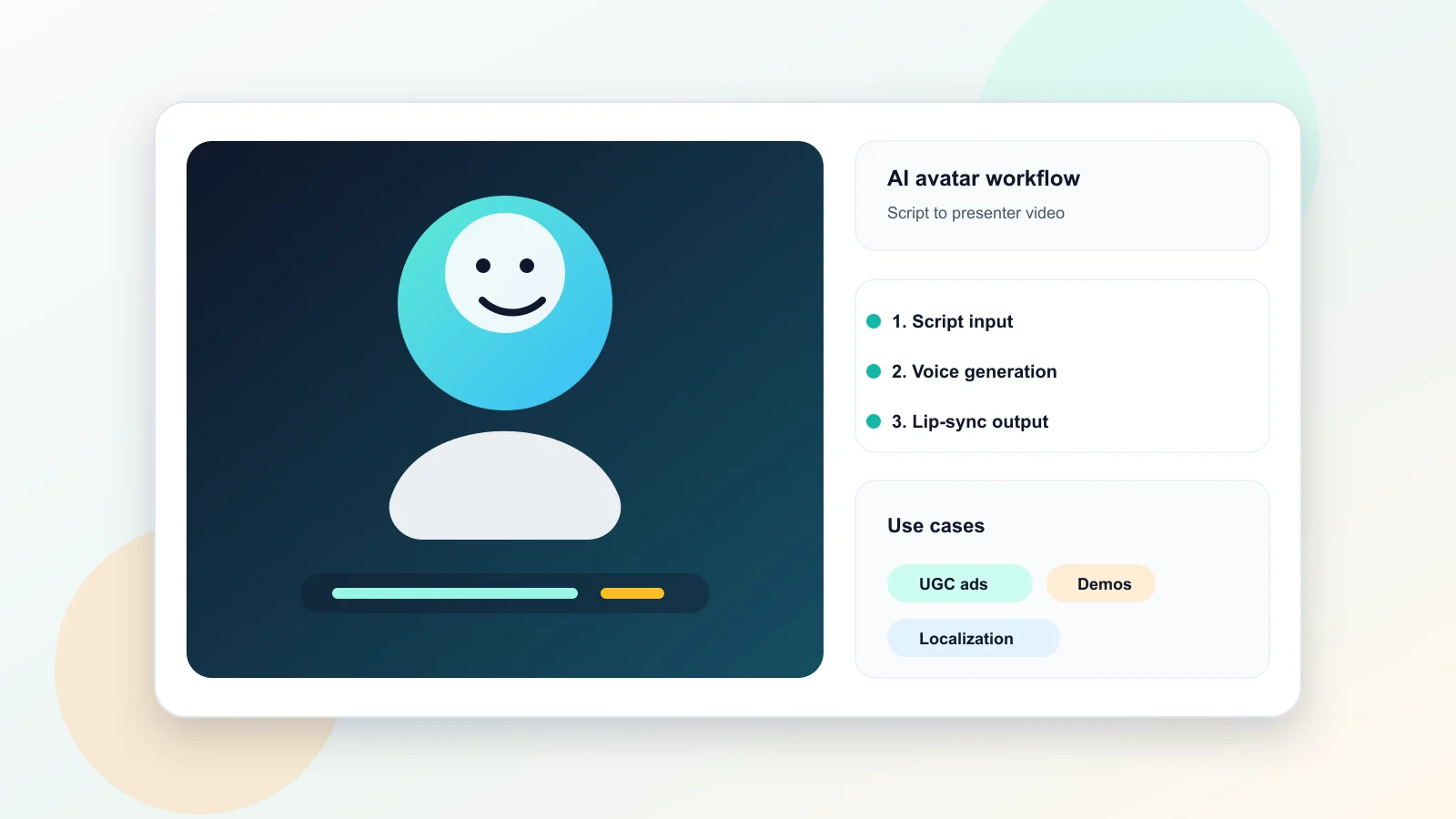
Most AI avatar tools follow a similar pipeline:
- Input. You provide a script, or the tool generates one from a prompt or product link.
- Avatar selection. You pick a stock avatar, upload a photo or video to create a custom avatar, or use your own trained avatar.
- Voice generation. The tool generates speech from text using AI voice models, often in multiple languages and accents.
- Lip-sync and animation. The platform syncs the avatar’s mouth movements and expressions to the generated audio.
- Output. You get a video file ready for ads, social posts, training content, or websites.
Some tools also support live or interactive avatars that respond in real time, but most marketing use cases focus on pre-recorded video output.
Main types of AI avatars
Stock avatars
Pre-made presenters included in a platform’s library. Useful for quick explainer videos, demos, and content where the presenter’s identity does not matter.
Custom avatars from a photo or short video
Created by uploading a photo, a short clip, or a few minutes of footage of a real person with consent. The platform then generates a digital version that can read any script in that person’s likeness.
Personal or twin avatars
A more advanced version of a custom avatar, often trained on a longer recording so the digital version more closely matches a specific person’s voice, expressions, and mannerisms. Common for founders, coaches, and creators who want to scale their own content.
Fully synthetic or stylized avatars
Characters that do not represent a real person at all, including illustrated, 3D, or stylized digital personas. These are common in explainer videos, education content, and brand mascots.
What AI avatars are used for
Advertising and UGC-style ads
Brands use AI avatars to create presenter-led ad variations for Meta, TikTok, and YouTube without booking a creator for every script. This is one of the fastest-growing use cases and overlaps heavily with AI UGC tools and AI UGC ad generators.
Product demos and ecommerce videos
An avatar can introduce a product, walk through features, or read a script over product footage, which is useful for ecommerce listings and product video content.
Explainers and training content
Businesses use avatars for onboarding, internal training, and SaaS explainer videos, since scripts can be updated and re-recorded instantly without reshoots.
Localization
Because the voice and script are generated, the same avatar can deliver the same message in multiple languages, which is useful for brands selling into several regions.
Personal branding at scale
Creators and founders use trained personal avatars to produce more video content than they could film themselves, while keeping a consistent on-camera presence.
What AI avatars are not good for
AI avatars are not a good fit when the message depends on proof that a real person actually used or experienced something. A testimonial-style ad built entirely on a synthetic avatar can come across as misleading if it implies a genuine customer experience.
They can also struggle with:
- highly emotional or nuanced delivery,
- content where audiences expect a known, real public figure,
- situations with legal or platform requirements for AI disclosure.
If proof and trust are the main goal, a real UGC creator or a hybrid approach is often a better fit than a fully synthetic avatar.
AI avatar vs AI UGC vs deepfake: what is the difference?
These terms get used loosely, so it helps to separate them.
| Term | What it usually means | Typical use |
|---|---|---|
| AI avatar | A digital character generated by software, used openly as a presenter | Ads, explainers, product demos |
| AI UGC | AI-generated content styled to look like creator-made social content | Paid social ads, hook testing |
| Deepfake | Manipulated media that places a real person’s likeness into content without consent or disclosure | Generally associated with misuse, not legitimate marketing |
Legitimate AI avatar tools require consent for custom avatars and are positioned as a production tool, not as a way to impersonate someone without their knowledge.
How to choose an AI avatar tool
Avatar quality and library
Check whether stock avatars look natural for your use case, and whether custom avatar creation is included or requires a higher plan.
Voice and language support
If you sell across regions, check the number of supported languages, accent quality, and whether voice cloning is available.
Script and editing tools
Look for built-in script generation, editing, captions, and the ability to swap scripts without rebuilding the whole video.
Commercial rights and usage limits
Confirm what you are allowed to do with the output, including ad usage, number of videos per month, and any watermark restrictions on lower plans.
Output format for your channel
If the goal is paid social ads, prioritize tools built for short-form vertical video. If the goal is training or SaaS explainers, prioritize tools built for longer-form presenter content.
For tool-by-tool comparisons, see best AI UGC tools and best AI avatar ad generators.
FAQs
Is an AI avatar the same as a deepfake?
Not in legitimate use. An AI avatar used with consent and disclosed as AI-generated is a production tool. A deepfake typically refers to manipulated content created without consent or used to deceive.
Can I create an AI avatar of myself?
Most platforms let you upload a photo or short video to create a custom avatar based on your own likeness, usually requiring you to confirm consent during setup.
Do AI avatars need to be disclosed in ads?
Disclosure requirements vary by platform and region. Many ad platforms and some jurisdictions require labeling AI-generated content, so check current platform policies before publishing.
Are AI avatars good for testimonials?
Generally not on their own. If the message implies a real customer experience, a synthetic avatar can mislead viewers. Real UGC or clearly framed “AI-generated example” content is safer.
What is the difference between an AI avatar and a virtual influencer?
A virtual influencer is usually a recurring branded character with its own persona and following, while an AI avatar is more often a presenter tool used to deliver a specific script or video.
This is general information, not legal advice. AI disclosure rules can change and vary by platform and region, so confirm current requirements before publishing AI avatar content in ads.